What the Stakes Actually Say
We don't hand over a pile of lath and hope for the best. Every mark we set ties back to the approved site and grading plans, and it carries a number that means something to whoever is running the machine. Along with the marks, we provide a cut-and-fill sheet so the crew builds to the right grade — how much dirt comes out of a spot, how much goes back in.
That sheet is the whole difference. A crew working off stakes alone can hit the mark left and right and still end up with a pad that ponds or a slab sitting four inches proud of where it belongs. The sheet gives them the vertical answer in writing, in feet and tenths, so the finish grade matches the plan instead of the operator's eye.
We set grade with digital levels, and we check it with the same instrument before we pack up. If a number is off, we find it while we're standing on the lot, not after the concrete truck leaves.
Working From the Plans, Not From Memory
What's signed off on paper is the source. Not a sketch, not what the lot looked like when you bought it, not what the last guy thought the property line was. We stake from the plans that got approved, and if what we find in the field doesn't match them, you hear about it from us before anything gets built.
Layouts are the part most people picture — the corners, the setbacks, the lines the walls follow. Grade is the part that decides whether water runs toward the house or away from it, whether a driveway meets the curb clean or leaves a lip. Get either one wrong and the plans on paper stop matching the dirt in front of you.
When the plans and the dirt disagree, that's a conversation, not a coin flip. We'd rather slow the job down for an hour than watch a crew build to a line that isn't there.
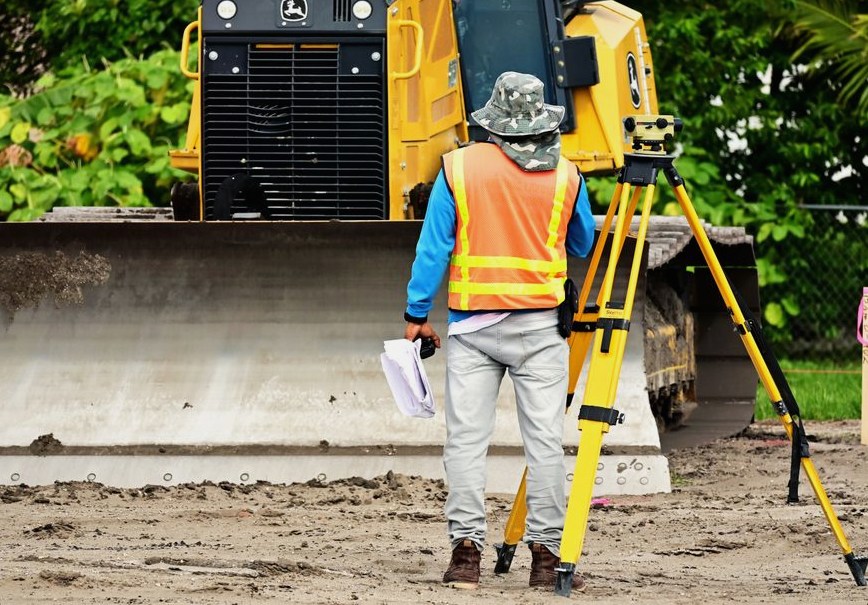
Stakes Get Moved. We Come Back.
Marks get disturbed. A machine clips one, the ground gets stripped, a sub runs a plate over a hub, somebody's dog knocks over a stake in the corner. It happens on every job — it's not a failure, it's the nature of building on a lot where things change daily.
So we re-stake as phases progress or marks get disturbed. Early rough grade takes one set of marks. Utility work takes another. Curb and flatwork take another. Each phase builds on the last, and if the previous marks are gone or unreliable by the time the next crew shows up, that crew is working blind.
Don't eyeball it. If a mark is missing and you think you remember where it was, that's exactly the moment to call instead of improvising. Re-staking a run is cheap. Tearing out a wall poured two feet off line is not.
What a Staking Run Costs
Utility or curb-line staking runs $400 to $1,200 per run. That's per run, and a lot rarely has just one — a sewer line, a water line, a curb line along the frontage can each get staked and priced separately.
Where you land in that range comes down to how much is being laid out and how much of it there is. A short, simple run on open ground sits at the low end. A longer line that has to be set and re-checked around existing improvements climbs. It's the work of getting the right marks in the right places at the right elevations, not a per-hour meter running while we stand around.
Get the number before the crew mobilizes. Staking is one of the smallest line items on a sitework budget and one of the few that can wreck the rest of it if it's skipped. Huntington Beach runs a mild coastal climate — about 654 cooling degree days a year — so staking work isn't weather-blocked the way it is in places with a real winter; a run scheduled in July looks about the same as one scheduled in January.
How It Works
-
Tell Us What You Need
Tell us what you need done and when — you'll get a straight answer, not a sales pitch.
-
Free On-Site Quote
We come out, look at the space, and confirm exactly what the job involves.
-
Written Quote
You get the scope and the price in writing before any work starts. No surprises.
-
We Do the Work
Our crew does the work, checks it, and leaves the site clean. You see everything we did.
In practice, on a job like this:
- Loading the engineered design coordinates into the field controller
- Setting offset stakes for the building corners so the forms have a reference
What to Expect to Pay
Typical ranges, not a fixed price - the exact number is confirmed in writing before work starts.
$500–$1500
Good to Know Before You Call
A boundary survey locates and marks your property lines. An ALTA/NSPS survey is a detailed standard used for commercial real-estate deals — it adds easements, improvements, and specific 'Table A' items that lenders and title insurers require. An ALTA is more thorough and costs more because it shows far more detail.
A survey establishes where the line legally sits based on the deeds and the monuments of record, and the sealed plat is the professional opinion a court relies on. It won't force your neighbor to agree, but it replaces guesswork with a defensible, licensed determination — which is usually what resolves the dispute or supports it if it goes further.
It's a form a licensed surveyor completes documenting your building's elevation relative to the base flood elevation. You'll need one to buy or reduce flood insurance in a mapped flood zone, or to support a Letter of Map Amendment if you believe your structure was mapped into a floodplain by mistake.
Yes. Where corners are missing we set stamped iron rods or caps carrying the surveyor's license number, and we flag them so you can find them. The markers are part of the record — moving or destroying them is both a practical problem and, in most states, against the law.
No. A phone's GPS is accurate to several feet at best and isn't tied to your deed or the corner monuments, so the lines those apps draw are approximate and carry no legal weight. Survey-grade GNSS fixes a point to the centimeter against a reference network — a different instrument for a different job.
The property address and, if you have them, a copy of your deed, any prior survey, and your title commitment. Access to walk the property helps, and if there's a specific reason for the survey — a fence, a sale, a building permit — telling us up front lets us scope it right the first time.
Price tracks the work, not the lot size alone. A clean platted lot with good corners is quick; a parcel with missing monuments, conflicting deeds, heavy tree cover, or a metes-and-bounds description takes far more research and field time. We quote after we see the deed and the record, so the number is real.
Serving Huntington Beach and Nearby
Serving Huntington Beach, CA. Call (657) 485-0473 to confirm coverage for your address.
Also Available
Why Huntington Beach {Who} Call
- Free Estimates
- The first visit and our honest read cost you nothing.
- We work around your schedule
- Off-hours if you need them — we find a time that works.
- We do exactly what we quoted
- The scope you approved is the work you get.
No-Pressure Inspections
Need help today? Call (657) 485-0473.